Product Visuals
March 30, 2026
AI Product Photography vs. Traditional Studios: The Real Cost Breakdown
I talk to e-commerce founders almost every day. And the same thing keeps coming up: "We know our photos suck. But we just can't afford to fix them."Here's the thing. They can. They just haven't seen the real numbers yet.
Let's talk money.
Not theory. Not "it depends." Actual numbers. What does it really cost to get good product photos on your store in 2026, and how does AI compare to hiring a photographer or booking a studio?
I'm going to break this down into three ways: traditional studio, freelance photographer, and AI. With real prices, including all the stuff nobody puts on their website.
By the end of this, you'll know exactly what you should be paying. And honestly, you'll probably be a little annoyed at what you've been paying until now.
The Number on the Quote Is Never the Number You Pay
This is the part that drives me crazy about the photography industry.
A studio will quote you $40 per image for white-background shots. Okay, sounds fine. But that $40 doesn't cover:
Shipping your products to the studio and back. That's $50 to $200 right there.
Retouching. $15 to $50 per image. This alone can double your cost and most studios treat it as a separate line item.
Studio rental. Sometimes it's included in the per-image price, sometimes it's $300 to $1,500 extra per day. You won't know until you ask.
Rush fees. Need it in under a week? Cool, add 25 to 100 percent.
Reshoots. Something went wrong? That's another 25 to 50 percent of the original session cost.
Usage rights. Some photographers charge extra for commercial use. Yes, really.
Your own team's time. Somebody has to coordinate all this. Review proofs. Manage revisions. That's easily 10+ hours per shoot at whatever your team costs per hour.
When you actually add everything up, research consistently shows that the hidden stuff makes up 40 to 60 percent of the total bill. Your $40 per image quote? In reality, you're paying $60 to $100.
I think of this as the iceberg problem. The quoted price is the part you can see. Everything underneath is what actually shows up on the invoice.
The Full Breakdown
Alright, here's where it gets interesting. I'm going to compare three approaches at three different catalog sizes, because the math changes a lot depending on how many products you have.
50 products, 5 images each (250 images total)
| Cost Factor | Traditional Studio | Freelancer | AI (Magic) |
|---|---|---|---|
| Base cost per image | $40–$75 | $25–$50 | $1–$3 |
| Retouching | $15–$30/image | $10–$20/image | Included |
| Studio/equipment | $500–$1,500 | Often included | $0 |
| Shipping products | $200–$400 | $100–$200 | $0 |
| Coordination time | $500–$750 | $500–$750 | $0 |
| Rush fees | $0–$2,000 | $0–$1,000 | $0 |
| Total | $15,000–$30,000 | $10,000–$20,000 | $250–$750 |
| Per image, all in | $60–$120 | $40–$80 | $0.5 |
| Timeline | 2–3 weeks | 1–2 weeks | 1–2 days |
500 products, 5 images each (2,500 images total)
| Cost Factor | Traditional Studio | Freelancer | AI (Magic) |
|---|---|---|---|
| Base cost per image | $30–$60 (volume discount) | $20–$40 | $0.50–$2 |
| Retouching | $10–$25/image | $10–$15/image | Included |
| Studio/equipment | $3,000–$6,000 | $1,500–$3,000 | $0 |
| Shipping products | $1,000–$2,000 | $500–$1,000 | $0 |
| Coordination time | $2,000–$3,000 | $2,000–$3,000 | $0 |
| Total | $125,000–$250,000 | $80,000–$150,000 | $1,250–$5,000 |
| Per image, all in | $50–$100 | $32–$60 | $0.3–$0.4 |
| Timeline | 4–8 weeks | 3–6 weeks | 3–5 days |
5,000 products, 5 images each (25,000 images total)
| Cost Factor | Traditional Studio | In-House Team | AI (Magic) |
|---|---|---|---|
| Annual production cost | $800K–$1.5M | $250K–$500K | $12,500–$50,000 |
| Per image, all in | $32–$60 | $10–$20 | $0.25–$0.4 |
| Full catalog timeline | 3–6 months | 2–4 months | 1–2 weeks |
| Seasonal refresh cost | Repeat 30–50% | Repeat 30–50% | Almost nothing |
| Flexibility for A/B tests | Very low | Low | Unlimited |
You see the pattern. Traditional costs go up in a straight line as you add products. AI costs barely move. The bigger your catalog, the bigger the gap.
But Does It Actually Look Good?
Fair question. And I want to give you a straight answer, not a sales pitch.
Where AI nails it:
White background product shots. This is where AI is genuinely hard to tell apart from studio work. Clean edges, consistent shadows, perfect white. If you sell on Amazon or Shopify and need marketplace-compliant images, AI handles this perfectly.
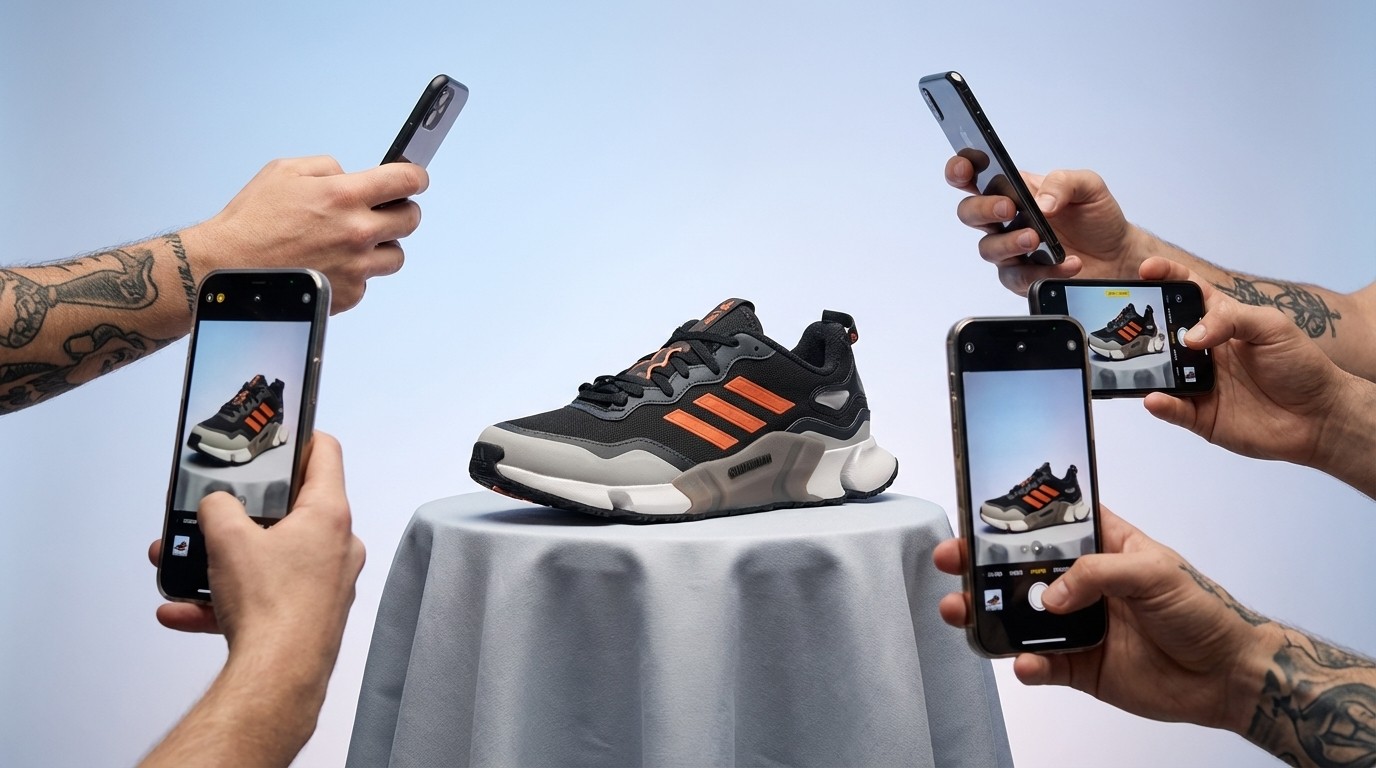
Lifestyle photos. You can place your product on a kitchen counter, an office desk, in a gym bag, whatever. AI generates the scene with realistic lighting and shadows. A studio would need to physically build each set. AI does it in seconds.
Consistency. Every image comes from the same template with the same lighting. With a studio, you get different results on different days, with different photographers, even at different times of day.
Format variations. Need the same shot in square for Amazon, 4:5 for Instagram, and wide for your website? AI does all three from one image. A studio would charge for each one separately.
Where studios still win:
High-end luxury products. If you're selling $10,000 watches or designer handbags, the emotional craftsmanship of a great photographer still matters. AI is getting closer but isn't fully there yet.
Really shiny or transparent stuff. Chrome, glass, mirrors. The physics of reflections is genuinely hard for AI. Results are usable but not perfect.
Products on real people. Clothing being worn, items being held and used. AI-generated models have gotten much better but a careful eye can still spot the difference sometimes.
Very specific creative vision. If your brand needs a particular photographer's style or a conceptual art direction, templates won't replace that.
The bottom line on quality: for 80 to 90 percent of normal e-commerce photography needs, AI is production-ready today. For the other 10 to 20 percent, you still want a photographer.
The smart brands I work with do both. AI for the volume work. Studio for the hero shots. That cuts their total photography budget by 70 to 90 percent and they still get premium images where it counts.
Speed Matters More Than You Think
Cost per image is only half the picture. The other half is time.
| What you're waiting for | Traditional Studio | AI |
|---|---|---|
| Briefing and scheduling | 3–5 days | None |
| Shipping products | 2–7 days | None |
| The actual shoot | 1–3 days | None |
| Editing and retouching | 3–7 days | Instant |
| Reviews and revisions | 2–5 days | Instant |
| Total | 2–4 weeks | Same day |
If you're a fast-moving brand, this time gap is just as valuable as the money you save. You can launch new products the same day instead of waiting weeks. You can test seasonal looks without planning months ahead. You can jump on trends by generating new visuals that afternoon. You can create 50 image variations for testing without spending a cent extra.
These aren't just nice-to-haves. They're competitive advantages. The brand that tests 50 versions of a product image and finds the winner will outsell the brand that's stuck with whatever the photographer happened to deliver.
When to Use What
After three years of watching brands figure this out, here's how I'd break it down:
Go all-in on AI if: You have 50+ products that need standard photos. You sell on marketplaces. You care about speed. You regularly update images for seasons or promotions. Your photography budget is under $5,000. You need the same images in multiple formats.
Mix AI with a studio if: You have a few hero products that deserve premium treatment. You're in fashion, luxury, or beauty where editorial quality matters for your brand. You need both high-volume catalog shots and flagship brand content. You have some products with tricky reflective surfaces.
Stick with a traditional studio if: You have fewer than 20 products total. Every single product needs custom creative direction. Your brand identity depends on one specific photographer's vision. You sell extremely high-value items where every pixel counts.
For the vast majority of e-commerce brands, and I really do mean 80 percent or more, the right answer is either all AI or a mix.
What This Looks Like in Real Life
Let me show you an actual case. Numbers shared with permission, brand name kept private.
The brand: DTC skincare, 120 products, selling on Shopify and Amazon.
What they were spending before: 120 products, 6 images each, $50 per image, including retouching. That's $36,000. Plus two seasonal refreshes per year at 40 products each. Another $12,000. Total annual budget: $48,000. They were producing about 1,200 images per year, each shoot cycle took around 3 weeks, and their team spent roughly 120 hours a year just coordinating.
What they spend now with Magic: $2,400 a year. And they're producing 4,800 images. Four times the volume. Each batch takes a day. Their team spends about 20 hours a year on it.
That's $45,600 saved. But here's the part nobody talks about in cost comparisons. They put that money into paid ads. Those ads generated $180,000 in new revenue. The real win wasn't cheaper photos. It was what they did with the money they freed up.
The Cost of Doing Nothing
There's one more number most brands never calculate: what bad product photos are already costing them right now.
Products with low-quality images convert up to 94 percent worse than products with professional photos. About 22 percent of online returns happen because the product "looked different in person." Shoppers are roughly 3 times more likely to buy from a listing with good multi-angle images.
So let's say your conversion rate is 2 percent and better photos could push it to 2.6 percent. That's a 30 percent improvement, which is actually conservative based on the data. For a store doing $500,000 a year, that's $150,000 in additional sales.
The cost of AI photography to get there? A few thousand dollars.
So the real question isn't whether you can afford AI product photography. It's whether you can afford to keep using what you have now.
Frequently Asked Questions
How much does AI product photography cost per image? Typically $0.30 to $3 depending on the tool and your plan. At Magic, our Pro pricing works out to about $0.07 per credit, and most images cost 5 credits. So roughly a dollar per image. Traditional studio photography runs $25 to $150 per image before retouching, and more like $40 to $200 when you include everything.
What are the hidden costs of traditional product photography? The ones people miss most often are retouching ($15 to $50 per image), shipping products to the studio ($50 to $200 round trip), rush fees (25 to 100 percent on top), reshoots (25 to 50 percent of the session cost), usage rights, and the hours your own team spends coordinating everything. These hidden costs usually add up to 40 to 60 percent of the total bill.
Is AI product photography good enough for Amazon? Yes. AI-generated images meet all Amazon requirements. White backgrounds, minimum resolution, accurate product representation, all of it. Plenty of top Amazon sellers already use AI for both their main listing images and lifestyle shots. Amazon doesn't require you to disclose that images are AI-generated.
When should I still hire a photographer? For premium luxury products, items with very reflective or transparent surfaces, big brand campaigns where you need a specific artistic vision, and apparel where you really need real human models. Most brands do well with a hybrid setup: AI for the bulk of the catalog, traditional for the flagship stuff.
How do I figure out what I'm actually paying per image right now? Take your last photoshoot and add up everything: photographer, studio, shipping both ways, styling, models if any, retouching, your team's hours at their hourly rate, plus any rush fees or reshoots. Then divide by the number of final usable images. Most people are surprised to find the real number is two to three times higher than what was on the original quote.
So What Now
Photography pricing has been confusing and overpriced for years. Studios quote per-image rates that leave out half the actual costs. Brands end up paying double or triple what they expected and just accept it because that's how it's always worked.
AI changed that. Not by making worse photos cheaper, but by getting rid of all the physical stuff that made photography expensive in the first place. No studio, no equipment, no shipping, no scheduling.
A dollar per image versus a hundred dollars per image. Same-day delivery versus a month. Unlimited variations versus paying for every single crop.
The brands that figure this out now get a real structural advantage. Everyone else catches up later and pays more for the same result.